A governor’s transition is a delivery problem, and the clock starts on election night
A transition turns campaign promises into a working government, and it succeeds or fails on operations. Lessons from Maryland and North Carolina.
This November, 36 states elect governors, and in 19 of them no incumbent is on the ballot. For the new governors among them, the weeks that follow are an administrative and operational hurdle, and a strategically important one.
A governor-elect has four to 10 weeks, depending on the state, to turn a campaign into a government. The promises made on the trail have to become a cabinet and a plan that can be carried out quickly, and the clock starts on election night. At Delivery Associates, we have supported transitions in several states, including helping design and execute Maryland’s 2022 transition and supporting North Carolina’s in 2024. We recently moderated a Milken Institute webinar on transitions and the first 100 days with the leaders who ran those two transitions. Several lessons stand out from that conversation and from our own work.
Be ready before the results are in
Cleo Hirsch, who directed Maryland’s 2022 transition for Gov. Wes Moore, said her core team was in place early with fully announced core team by Nov. 14. It included the chief of staff, deputy chiefs, and the appointments, legislative, budget, and legal leads.
People came first in both states. “The people are the most important part,” Hirsch said. A governor-elect has little time to meet many candidates, so the transition team has to build a strong slate and a process for getting final selections to the governor.
Christie McNeill, who led North Carolina’s 2024 transition for Gov. Josh Stein, said landing a great cabinet and senior team paid off most. Her team ran an inclusive selection process for secretaries and lined up candidates for each agency’s top communications, legislative, policy, legal, and deputy roles. Secretaries arrived in January with a slate of candidates already screened, and most had their teams formed within the first several weeks.
Give the work one North Star
When we begin supporting a transition, we ask teams early on to define their North Star: if the transition succeeds beyond their wildest dreams, what will be true on Day 1 about their new government and the people it serves?
In Maryland, the vision was clear. Hirsch said the goal was to establish “the most inclusive and transparent transition in Maryland’s history.” From this vision, we worked with Maryland’s transition team to organize nine policy committees with 208 members when they were named, each responsible for intaking and facilitating input from the public at large. Hirsch said the committees were focused on what the governor ran on and how to deliver it, which meant “turning from policy to operations and action.”
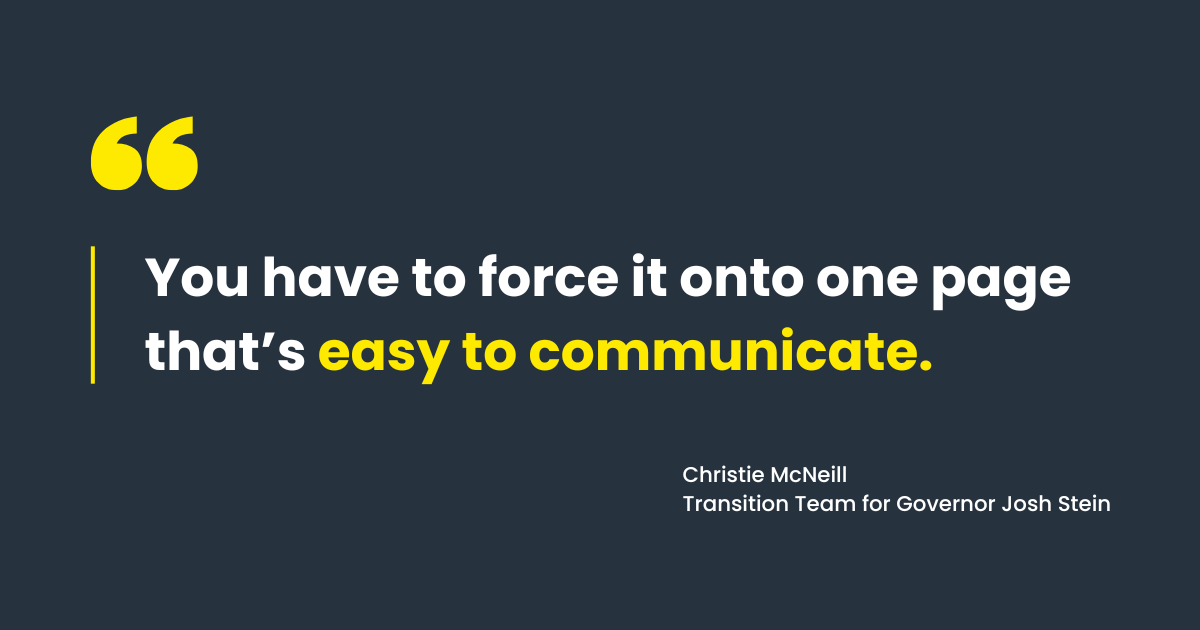
McNeill’s team distilled the campaign’s promises into a one-page North Star: meaningful opportunity for all North Carolinians, built on four pillars (economic opportunity, excellent schools, healthier families, and safe communities), with Hurricane Helene recovery and modernizing government underneath. “You have to force it onto one page that’s easy to communicate,” she said.
In both models, the North Star gave every transition member the same answer to what the committee is producing and for whom. It also gives the administration a way to check early hires and decisions against what voters were promised.
A North Star covers what the campaign promised, and in our view it also needs a short list of three to five issues the team must be ready to handle on Day 1 that were never in the platform, such as a disaster or a problem inherited from the last administration. North Carolina put Hurricane Helene recovery, one of the worst hurricane in the state’s history, under its four pillars as a Day 1 priority. Handling issues like these well builds confidence even when they sit outside the policy agenda.
Broaden the tent, and make it easy to join
Maryland called its approach a “civic transition” and kept it open to public participation, with a website, white-paper submissions, at-large committee seats, and town halls. Hirsch, who directed the transition, credits that openness with building momentum that carried into the first legislative session, and says the ENOUGH Initiative, Maryland’s effort to reduce child poverty through place-based investment, grew out of conversations from a broad coalition during the transition.
North Carolina made its committees bipartisan, with about 10 committee members per cabinet agency from across sectors and regions. McNeill said that was important in what she called “a very purple state.” An open process also widens the talent pool. McNeill recalled more than 3,000 candidates for state jobs, and she advises beginning outreach to potential leaders before the election result is known, since a move into government can take time to consider.
The lesson to take away here: a governor-elect should keep in mind the key people they want on their side well before election night, so strong future state leaders are alongside them and ready to deliver by Day 1.

Build the operating system with scale in mind
A wide tent creates volume, and volume requires systems to manage. “The technology side of this is not to be underestimated,” McNeill said. North Carolina’s candidate portal fed a database the team used to track résumés, schedule interviews, and coordinate roughly 100 committee members, which produced late nights for the team. She urges incoming teams to map every step and think carefully about how to build scalable technology and operating tools in advance.
Then, the work continues once the cabinet is in place. Handoff memos from the outgoing administration helped, McNeill said, but every team still had to learn directly, going several layers into each agency. In our experience, setting communication norms at the start of a transition, including how ideas and decisions move between the teams handing off work, keeps knowledge transfer clear when the calendar is tight.
We facilitated a series of cabinet and policy retreats for the incoming cabinet and Governor’s Office staff, where incoming secretaries and veterans of prior administrations shared what they were learning in a structured process. Hirsch added that incoming leaders should never underestimate “the value of career public servants.” In our experience, retreats are one opportunity to bring incoming and career leaders together in one forum.

Treat the sprint as the start of the marathon
A transition lasts weeks, and the government it launches runs for years. The systems built in the sprint have to keep working once the marathon of governing begins, and Hirsch said strong systems “will get you very far.” No transition is perfect, Hirsch said, and time is the scarcest resource, so incoming teams should go in with “a lot of grace” and an appetite to be scrappy.
An incoming team can start with two decisions: who will be in the room on Day 1, and what the first 100 days are for. The first means naming the core team and the senior leaders the governor-elect wants beside them. The second means a one-page North Star and a short list of the issues that cannot wait. Settling both early on the results are in is the difference between a campaign’s vision and a government ready to deliver on it in January.
Learn more about how we can help at info@deliveryassociates.com
Interested in Learning More?
Partner with Delivery Associates to turn your boldest goals into measurable, lasting outcomes. Let's explore how we can create impact—together.
Incoming state education leaders should build reforms into the system within their first 100 days so that they outlast anyone in the job