First 100 Days: Make Your Education Strategy Outlive You
Incoming state education leaders should build reforms into the system within their first 100 days so that they outlast anyone in the job
Day one is when you decide if your education strategy outlives you
You are about to take a senior role in state education, as a governor, a commissioner, superintendent, chief academic officer, or a deputy. But the results people will judge you by will mostly reflect decisions made by your predecessors. And the results that validate many of your own actions won’t arrive until after you’ve moved on.
At least 19 states will have a new governor in 2027 following elections on Nov. 3, and they’ll bring with them new education leaders. If you are one of them, good decisions you make about schools and students in your first 100 days may take years to show up in student outcomes.
Whether anyone is still driving your work when those results arrive is something you can decide now.
You have a plan. Most of what you’re about to build isn’t guaranteed to survive your own departure, no matter how good it is. But you can control whether your reforms outlast you by building them into the system in your first 100 days, so that they keep running whether or not you are there.

Your entry plan: day one is not a grace period
Your instinct as an incoming leader will be to dive straight into agenda-setting. You were brought in, after all, to create change and produce results.
But as you write your entry plan you’ll face the same choice as every incoming leader: let a single champion decide what gets done and how, or build the work into a structure that runs whether that champion is in the room or not.
That choice gets made early, usually by default, without anyone noticing, and it applies to inherited initiatives just as much as anything you’re building new. The decision to keep, cut, or replace what the previous administration started is yours to make. But whatever you decide to continue should get the same discipline as anything new. Half-adopted legacy programs are the most fragile thing in any agency, because no one’s decided whose job it is to keep them running.
A brand-new initiative requires the same choice on day one. Build it into a role and a structure now, or it’s already headed toward becoming personal habit, no different from the legacy program you just inherited.
Reforms don’t fail because leaders leave. They fail because delivery was built on personal effort instead of institutional structure. That was true of your predecessor’s agenda, and it will be true of yours too, unless you build differently from day one.
Three things to build into your strategy from day one
1. Give the routine an owner who isn’t you.
Any recurring check-in on progress, monthly review of whether a program is on track, or regular meeting to fix what’s not working, exists because someone convenes it. If that someone is you, it stops the day you leave, get reassigned, or get too busy to send the invite. If it’s written into a role’s responsibilities, a formal delegation, or a meeting already on the calendar for other reasons, it keeps happening because someone is still accountable for it, whether or not you’re in the building.
New York City created a formal delegation in the shape of an office, to better coordinate early childhood education and childcare. Multiple agencies were previously involved in different aspects of this, some funding childcare, others delivering services, and others responsible for oversight and quality assurance. They lacked a shared forum or regular cadence that aligned them around children’s and families’ needs.
In 2023, Delivery Associates helped set up the Mayor’s Office of Child Care and Early Childhood Education as a central hub for policy implementation and coordination, giving the city a common roadmap in these areas. It has outlasted a change of mayor and is now responsible for delivering the Mamdani administration’s universal childcare priority.
A new administration can still eliminate a role or unit, so make eliminating it costly. Write the duty into statute or board policy with its own budget line, and make it responsible for a public report. Then removing it means explaining why the reporting stopped, which is a harder conversation than a quiet reorganization.

2. Report targets publicly from the start.
A number you track on a spreadsheet is something only you need to care about. A goal reported to the legislature or the board means someone else now expects an update and that expectation doesn’t disappear when you do. It becomes a standing expectation on whoever holds your job next, so your successor either keeps tracking it or has to explain publicly why they stopped.
We helped Indiana build this kind of structure into its Career Scholarship Account (CSA) program, created to give $5,000 annually toward work-based learning opportunities to high school students in grades 10-12. A yearly application target was written into statute, with a team built specifically to track and report progress against it. This meant that hitting the number was never one administrator’s responsibility.
3. Build a coalition beyond the state agency.
Get legislators, board members, and business and community stakeholders publicly invested early. Durability comes from external actors having a stake in a program’s outcome, so that unwinding it carries a cost that outlasts any one administrator.
Colorado has done this with Elevate Quantum, the federally designated multistate Tech Hub it began with New Mexico and which now includes Wyoming. It aims to create 10,000 quantum-computing jobs with the pipeline starting in K-12 classrooms and community colleges. We helped build the coalition that now brings together more than 120 actors including school districts, technology companies, economic development organizations, institutions of higher education, and state agencies.
While the incumbent governors of Colorado and New Mexico aren't on the ballot on Nov. 3, the structures they’ve put in place will ensure this coalition endures beyond their administrations.
Day one diagnostic tool
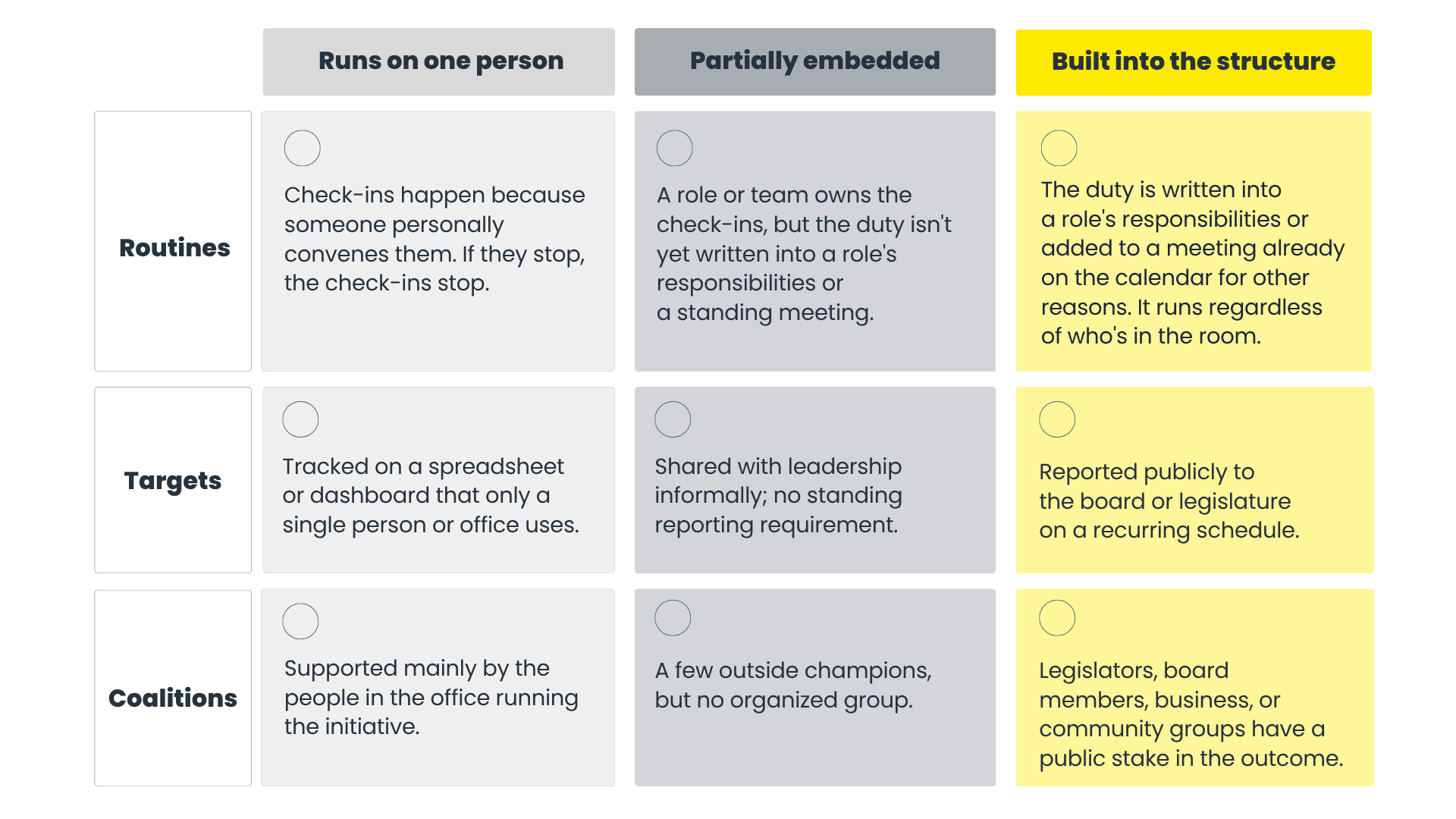
Consider an initiative in your entry plan, one specific program or policy, not your whole agenda. Walk it through all three categories: routines, targets and coalitions. For each one, mark where that initiative sits today, not where you plan to take it.
Interpreting your results
Mostly “runs on one person”? This initiative is unlikely to survive a change in leadership. Pick the easiest element to fix and make a start.
A mix of answers? Start with the ones marked “partially embedded.” Those are closest to done and will give you the fastest wins.
Mostly “built into the structure”? You’re in good shape. Check back periodically to make sure that stays true.
In the first 100 days, a new state education leader should build each reform into the system so it keeps running whether or not they are there. That means giving every recurring routine an owner other than themselves, reporting targets publicly from the start, and building a coalition beyond the state agency.
Education reforms end when a leader leaves because delivery depended on that person’s effort instead of an institutional structure. Check-ins stop when the person who convenes them goes, and a number tracked on one person’s spreadsheet is dropped. Results also take years to appear, so a successor often can’t yet tell whether the change worked and has little reason to keep it.
An entry plan covers a leader’s first months: listening, diagnosis and early wins. A strategy that outlasts you covers what is still running after your last day, meaning who owns the routine, who expects the numbers and who has a stake in the result. The entry plan tells you how to start, and the structure you build into it decides whether the work keeps going.
Interested in Learning More?
Partner with Delivery Associates to turn your boldest goals into measurable, lasting outcomes. Let's explore how we can create impact—together.

In Delaware, a study found that students who complete work-based learning experiences are more than twice as likely to enter jobs aligned with their high school pathway, and those pathway-aligned jobs carry a substantial wage premium. Most states cannot produce evidence like this, even as they make work-based learning a centerpiece of their career pathways strategies.