
The trust gap governments can't talk their way out of
Listening to citizens was supposed to rebuild confidence in government. The data says something else is missing.
Trust in public institutions is declining, or at best flatlining. In September 2025, 17% of Americans said they trusted the federal government to do what was right most or all of the time, down from 73% in 1958, the first year Pew Research Center asked the question. Across the Organisation for Economic Co-operation and Development (OECD) and its participating countries, the picture is less severe but no less troubling: trust in national government has stopped falling since 2023, holding at around 40%. Stabilizing at a low level is not the same as recovering.
Much of the effort to rebuild that trust has centered on community engagement, especially at the local level, where most implementation happens. But between the promises campaigns make and the policies that follow, something keeps breaking down: the gap between a commitment made by leaders, and visible signs of successful delivery.
The data confirms it. Only 39% of people believe a public consultation actually changes what government does, according to the OECD. People do not just want to be heard. They want to see follow-through. That gap, more than the erosion itself, is the real story.
This is a pattern Delivery Associates (DA) has watched repeat across governments for more than a decade. Closing it has less to do with how governments listen than with four things they do next: giving public servants permission to surface problems early, measuring what is actually happening on the ground, closing the loop with citizens in public, and treating policy and implementation as something to adjust rather than defend.
Listening is not the same as being trusted
Nick Rodriguez, DA’s CEO, has watched this pattern repeat across sectors and geographies. "Where implementation breaks down," he said, "is that after the announcement is over and the cameras have gone away, and we are just sort of working at trying to follow through on those commitments, we haven't built the systems, the operational capacity, or the implementation muscle to actually follow through and deliver on them." The dissonance between what a government promises and what people experience, he argued, is what erodes trust, even when the underlying policy is sound.
Laurel Blatchford, a Director at DA who previously served as Chief Implementation Officer for the Inflation Reduction Act at the Department of the Treasury, has seen the same gap from inside government. At Treasury, the tax policy guidance behind the law's clean energy credits was, in her words, exactly what the department does best. What was most challenging was all the other pieces: meaningful engagement with communities accessing these benefits, operationalizing the new credits in partnership with the Internal Revenue Service (IRS), making the benefit accessible to varied taxpayers and communities, and raising awareness of the bill's many programs with populations who did not know the credits existed. The policy was sound. The delivery architecture around it was not as effective as it could have been, and the people it was meant to reach did not always feel its benefit.
What actually rebuilds trust
Build internal permission to surface problems early. Closing the gap between promise and delivery depends on culture as much as strategy. Ashleigh O'Mahony, an Associate Director at DA who previously coordinated Western Australia's COVID-19 response for the state government, has argued that public servants often default to reporting a program as on track even when it is not, because there is no safe way to say otherwise. Rebuilding trust starts with giving teams explicit permission to surface problems early, before they become public failures rather than after. Without that shift, a government cannot close a feedback loop in public, because its own teams were never honest about what the feedback revealed in the first place.

Diagnose the problem well enough to solve it. In 2022, the Bahamas Ministry of Education, in partnership with the Prime Minister's Delivery Unit, identified 10 schools where more than 30% of students had missed half the school year. Instead of stopping at that diagnosis, the unit traced the root cause at each school, and the Ministry responded directly: supply support for families, a hotline to report absent students, and direct outreach to chronically absent families. Within one year, chronic absenteeism fell by 94%, and severe absenteeism by 96%. Attendance then became one of the criteria used to select schools for a national school breakfast program, which was itself identified as necessary to address the same problem. That program grew from 13 schools in 2023–2024 to 118 by the end of the 2025–2026 school year, serving more than 2 million meals to 20,750 students. The lesson, at both scales, was to measure precisely enough to know what is working, then act on it.
Close the loop in public, not just internally. When citizen feedback changes a decision or impacts program design or delivery, the change needs to show up somewhere the people who gave the feedback can actually see it. This is the direct answer to the OECD's 39% finding: a consultation that produces no visible outcome will read as theater, regardless of how much internal analysis it generated.
Treat policy and implementation as iterative, not fixed. During Western Australia's COVID-19 response, O'Mahony's team built weekly feedback loops with industry, adjusting policy as new information came in rather than treating the initial plan as final. She has described this as the difference between policy done in isolation and policy that survives contact with reality: governments that build in routine mechanisms to learn what is and is not working, and act on it quickly, sustain public confidence even through a genuine crisis.
This is the precondition beneath the other three practices. A government cannot close a feedback loop in public if its own teams have not been honest about what the feedback revealed. O'Mahony's clearest point on this: leaders who create space for public servants to report bad news, rather than defaulting to "everything is on track," catch problems while they are still fixable rather than after they have become the subject of a headline.
The proof, not the promise
Trust returns when a government proves that listening changed something people can see and feel. That is a harder standard than running a consultation, and a more durable one. It is also, at its core, a description of delivery: defining what success looks like, measuring it honestly, and adjusting in view of what the evidence shows. Delivery Associates has spent more than a decade helping governments build exactly this kind of system. The unglamorous work of follow-through, not the announcement that precedes it, is where public trust is actually made or lost.
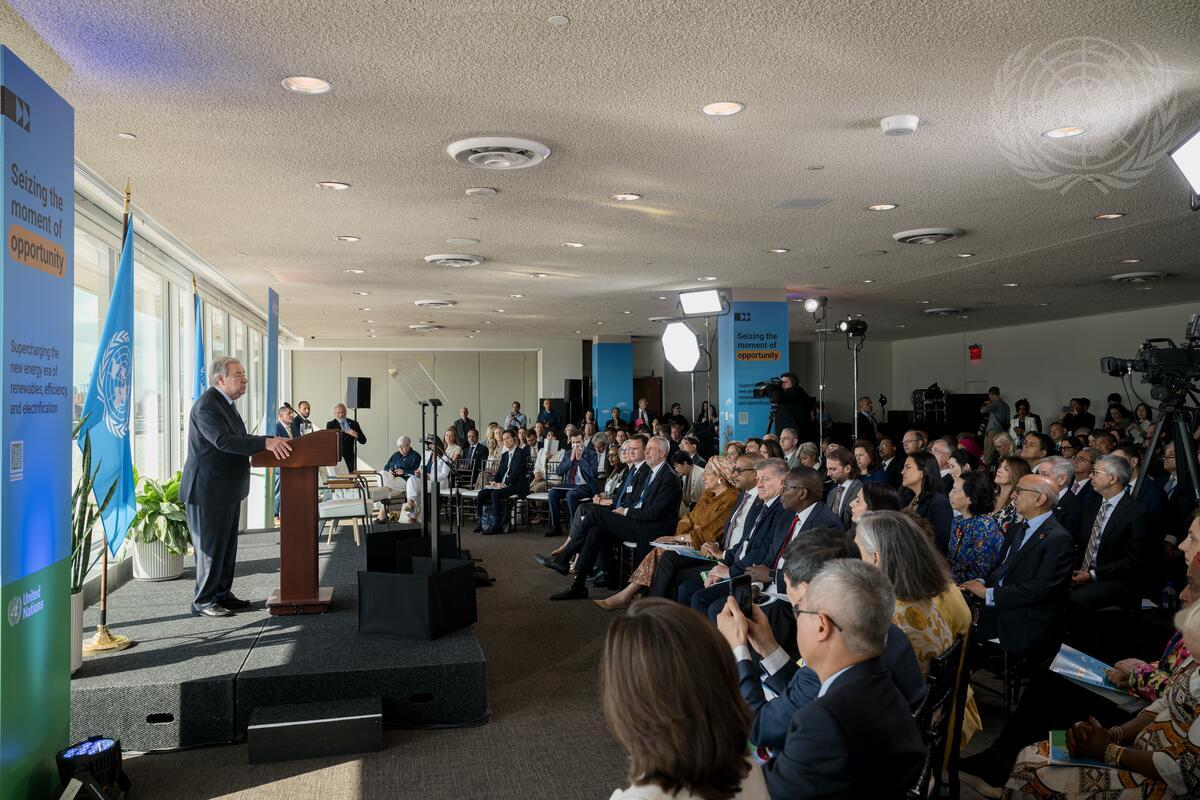
Photo by UN Photo/Mark Garten
Interested in Learning More?
Partner with Delivery Associates to turn your boldest goals into measurable, lasting outcomes. Let's explore how we can create impact—together.